Ceiling height guide
Golf Simulator Ceiling Height Requirements
Questions, or want a custom golf sim designed?
ContactBuilt In Golf · Planning guides for home installs in Canada
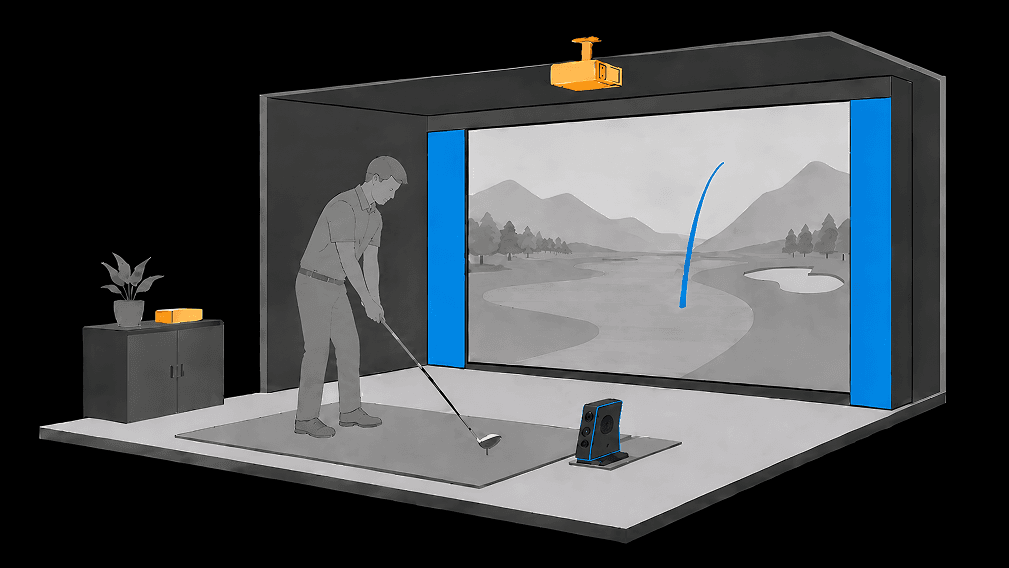
For a home golf simulator that handles full swings with every club, 10 feet of ceiling height is ideal, 9 feet is the recommended minimum, and 8.5 feet is the practical absolute minimum. Golfers shorter than about 5 ft 8 in can often play comfortably under a 9-foot ceiling, while taller players and steep, upright swings are safer at 10 feet or more.
A reliable rule of thumb: your ceiling should sit roughly 6 to 9 inches above the highest point of your swing (your swing apex), so the clubhead never feels like it is threatening the ceiling. Because that apex depends on your height and swing plane, not the room, the only true minimum is the one your own driver swing confirms.
You can still build in less. Even 8-foot spaces are genuinely useful for iron and short-game practice with the right swing and a floor-based launch monitor. And ceiling height is the one constraint you cannot easily change later, so getting it right up front means the screen, turf, launch monitor, and finishes all fall into place around it.
What you get at each ceiling height
| Ceiling height | Verdict | What to expect |
|---|---|---|
Under 8 ft < 2.44 m | Not recommended | Full swings are unsafe for most adults. Usable only for putting, chipping, and short-game work, not a true driver-capable room. |
8 ft 2.44 m | Tight | Workable for shorter players and iron-focused practice with a flatter swing and a floor-based launch monitor. Driver clearance is the limiting factor and must be tested. |
8.5 ft 2.59 m | Workable | Fine for many golfers up to roughly 6 ft with a controlled swing. Verify your own driver arc before committing hardware. |
9 ft 2.74 m | Comfortable | The practical sweet spot for most adult golfers. Full swings with every club in the bag are realistic for average heights. |
10 ft 3.05 m | Ideal | Confident full-driver swings for taller players, plus headroom for overhead launch monitors and premium enclosures. |
10 ft + 3.05 m + | Best-in-class | No swing compromises, easy overhead camera mounting, and room for ceiling treatments, lighting, and cabinetry. |
These ranges are practical guidance, not hard rules. A confident, compact swing needs less height than a long, upright one, which is why we always verify with a real swing test rather than a tape measure alone.
Ceiling height by player height
| Player height | Recommended | Workable minimum |
|---|---|---|
| Up to 5 ft 8 in | 9 ft | 8.5 ft |
| 5 ft 8 in – 6 ft 0 in | 9 – 10 ft | 9 ft |
| 6 ft 0 in – 6 ft 4 in | 10 ft | 9.5 ft |
| 6 ft 4 in + | 10 ft + | 10 ft |
Note the “workable minimum” assumes a controlled swing and a floor or side-mounted launch monitor. Add roughly a foot if you plan to mount an overhead camera system.
How to measure the height you actually need
The alignment stick test
Tape an alignment stick to your driver (or use an extra-long club), stand where you would hit, and make slow, full swings. If the tip clips the ceiling, or you feel any hesitation, the space is too low. This is the single most reliable check.
Add 6–9 inches of margin
Give yourself roughly 6 to 9 inches above the highest point the clubhead reaches. You never want to steer the swing to avoid the ceiling, because that quietly changes how you play and what the room measures.
Account for the build
Subtract the hitting mat thickness and tee height, then measure below any ducts, beams, or dropped ceiling. The usable clearance, not the raw ceiling, is the number that decides the room.
Room dimensions (with metric)
| Dimension | Minimum | Recommended |
|---|---|---|
| Ceiling height | 8.5 ft / 2.6 m | 10 ft / 3.0 m |
| Width | 10 ft / 3.0 m | 12–15 ft / 3.7–4.6 m |
| Depth | 12 ft / 3.7 m | 15–18 ft / 4.6–5.5 m |
Width should let you stand comfortably left or right-handed with the screen centred; depth covers your distance from the screen plus room behind the ball for the launch monitor and your stance.
Working with 8 to 8.5 feet
A low ceiling does not rule out a great simulator. It just changes the design. Plenty of enjoyable, genuinely useful rooms are built at 8 to 8.5 feet by planning around the constraint instead of fighting it.
The most effective moves are choosing a floor or side-mounted launch monitor so nothing competes with the swing overhead, leaning into a slightly flatter or three-quarter swing, and positioning the hitting area to maximise the clearance you have. For basements specifically, exposing the joists rather than adding a drop ceiling can recover several valuable inches.
It also helps to be honest about goals. If short-game sharpness, iron consistency, and year-round reps are the priority, a low room delivers enormous value. If uninhibited driver bombing is non-negotiable, a taller space like a garage may be the better home for the build.
Low-ceiling checklist
- Choose a floor or side launch monitor, not overhead
- Expose joists instead of a drop ceiling where possible
- Plan a flatter, more compact swing
- Use a thinner hitting mat to reclaim clearance
- Prioritise irons, wedges, and short-game modes
- Test the driver before committing hardware
Overhead vs floor-based units
Overhead camera systems
Ceiling-mounted units like Uneekor overhead models, and overhead radar/camera configurations, read the ball and club from above. They are excellent, but they consume overhead space for both the unit and its mounting depth, so they favour rooms at roughly 9.5 to 10 feet or more.
Floor & side-mounted systems
Units that sit beside or behind the ball, such as Foresight GC3 and GCQuad, SkyTrak, and radar monitors, leave the ceiling free for your swing. In lower rooms they are usually the smarter choice because clearance goes entirely to the player.
We install and calibrate both approaches. See launch monitor integration for how brand choice interacts with room geometry.
Ceiling height in local homes
Most simulator rooms in Toronto and the GTA end up in the basement, where finished ceilings commonly land between 8 and 9 feet. Older homes trend lower, while newer builds and custom homes increasingly offer 9-foot-plus basements that are excellent for simulators.
The complication is rarely the raw height. It is the ductwork, beams, and bulkheads that cut into usable clearance right where you want to swing. Placement matters enormously: shifting the hitting zone a few feet to sit under the highest part of the ceiling can be the difference between a restricted room and a comfortable one.
That is exactly what our basement simulator builds are designed around, and why every project starts by verifying real clearance on site rather than trusting a floor plan.
FAQ
What is the minimum ceiling height for a golf simulator?+
For full swings, 9 to 10 feet is comfortable for most adult golfers, and 8.5 feet is workable for many players under about 6 feet. Eight-foot ceilings are possible with compromises: a flatter swing, a floor-based launch monitor, and an iron focus. Because clearance depends on your height and swing arc rather than room dimensions alone, the only reliable minimum is the one confirmed by testing your own driver swing in the space.
Can you put a golf simulator in a room with 8-foot ceilings?+
Yes, with realistic expectations. An 8-foot room suits shorter players, iron and wedge practice, and short-game work. You can improve it with a flatter or three-quarter swing, choking down or using slightly shorter clubs, standing a little farther from the screen, and choosing a floor or side launch monitor instead of an overhead camera. Driver swings are the constraint and should always be tested first.
How much ceiling height do I need to swing a driver?+
Driver clearance is the tallest point of your swing, not your standing height. Most adult golfers want 9 to 10 feet for unrestricted driver swings, while players over about 6 feet are more comfortable at 10 feet or more. The safest approach is a slow-motion swing test with your longest club to find where the clubhead actually reaches at the top and through impact.
Do overhead launch monitors need more ceiling height?+
Yes. Overhead camera systems such as Uneekor or ceiling-mounted setups need clearance for both the swing and the unit itself, plus mounting depth below the ceiling. In lower rooms, floor and side units, for example SkyTrak, Foresight GC3 or GCQuad, and radar-based monitors, are usually the better fit because they do not consume overhead space.
How do I measure the ceiling height I actually need?+
Stand where you will hit and make a slow, full swing with your driver, watching the highest point the clubhead reaches on the backswing and follow-through. Add a margin of safety above that point, then account for the hitting mat raising you off the floor and any tee height. Compare the total to your finished ceiling height, remembering that ducts, beams, and drop ceilings reduce the usable number.
Does the hitting mat affect ceiling clearance?+
Yes. A hitting mat raises you roughly half an inch to an inch and a half off the floor, which directly reduces your effective overhead clearance. When you are close to a limit, the mat thickness and tee height genuinely matter and should be included in the measurement.
Can I gain ceiling height in a basement?+
Sometimes. Exposing floor joists instead of installing a drop ceiling, removing an existing dropped ceiling, or recessing the hitting area can each recover a few inches. Ductwork, beams, and bulkheads have to be planned around rather than removed, so a feasibility visit is the best way to confirm how much usable height a specific basement really has.
What if my ceiling is too low for a full driver swing?+
You still have good options. Many low-ceiling rooms deliver excellent iron, wedge, and short-game practice, which is where most scoring improvement happens. If a full driver swing is essential, a taller space such as a garage or an addition may be the better home for the build. A design consultation maps the realistic experience for your exact room before you spend on hardware.
Is an 8.5-foot ceiling enough for a golf simulator?+
For many golfers, yes. An 8.5-foot ceiling is widely considered the practical absolute minimum for full swings and works for players up to roughly 6 feet with a controlled swing and a floor or side-mounted launch monitor. Taller golfers and steep, upright swing planes can still clip it, so an alignment stick test with your driver is essential before committing.
How do I calculate the ceiling height I need?+
Use a simple formula instead of a generic calculator: find the highest point your clubhead reaches on a slow, full driver swing (your swing apex), then add 6 to 9 inches of clearance, plus the thickness of your hitting mat. Most adult golfers arrive between 9 and 10 feet. Because swing apex depends on your body and swing, a real swing test in the room is always more accurate than an online estimate.
Why do some golfers say 9 feet still feels too low?+
It comes up constantly in golf simulator forums and Reddit threads, and it is usually about height and swing style. A tall player or a powerful, upright swing can reach the ceiling even at 9 feet, while a shorter or more compact swinger is perfectly comfortable there. That variation is exactly why 10 feet is the safe recommendation and why we verify with an in-person swing test rather than trusting a single number.
Can I build a DIY golf simulator under a low ceiling?+
Yes. The same physics apply to DIY and professional builds. Prioritise a floor-based launch monitor, plan a flatter swing, use a thinner hitting mat to reclaim clearance, and test your driver before buying anything. If your space is borderline, a quick feasibility check is worth it to avoid an expensive room that cannot handle the clubs you actually want to hit.