Cost guide
How much does a golf simulator cost?
Questions, or want a custom golf sim designed?
ContactBuilt In Golf · Planning guides for home installs in Canada
A usable home setup can start around $500 – $3,000 for a DIY net-and-launch-monitor practice bay, land between $3,500 and $15,000 for a common DIY projector room, and run $35,000 – $85,000+ for a finished custom install with framing, turf, acoustics, projection, and calibration handled as one project.
Below about $500, improvised practice still exists: a mat, a net, and maybe a free app. Kit and package bays in the teens or twenties can buy better hardware in a ready room, but they are still mostly equipment, not a built-in finish. Luxury and estate entertainment rooms often sit at $85,000 – $250,000+ when millwork, lounge design, or major renovation work expand the scope.
The confusing part is that “golf simulator cost” and “cost to install a golf simulator” are not the same question. One is mostly hardware. The other includes the room. Budget against the result you actually want.
What different budgets actually buy
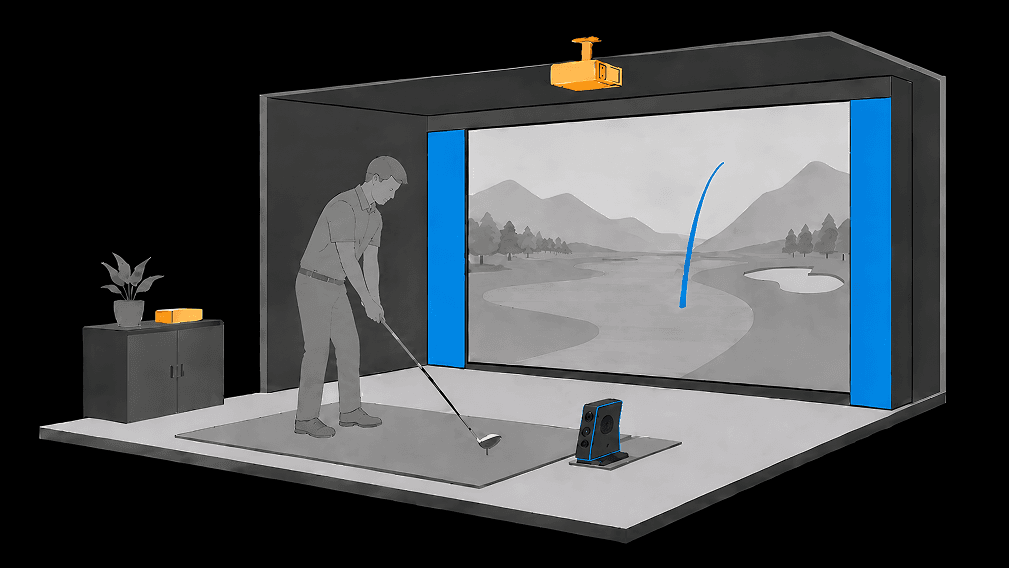
Under about $500, you are testing whether indoor practice is worth it at all. From roughly $500 to $3,000, an entry launch monitor adds real numbers, but course play is limited without a projector. DIY projector bays from about $3,500 to $15,000 are where most serious self-builds land. What fails there is rarely the monitor SKU. It is a wrinkled screen, a washed-out projector, visible cables, and a room that echoes so loudly nobody wants to play after 8 p.m.
Around $12,000 – $30,000, kit and package bays usually mean stronger hardware and paid mounting in a room that is already mostly ready. That can play better than pure DIY. It is still not a finished golf room built into the home. Acoustics, concealed wiring, turf transitions, lighting, and millwork are often thin or missing.
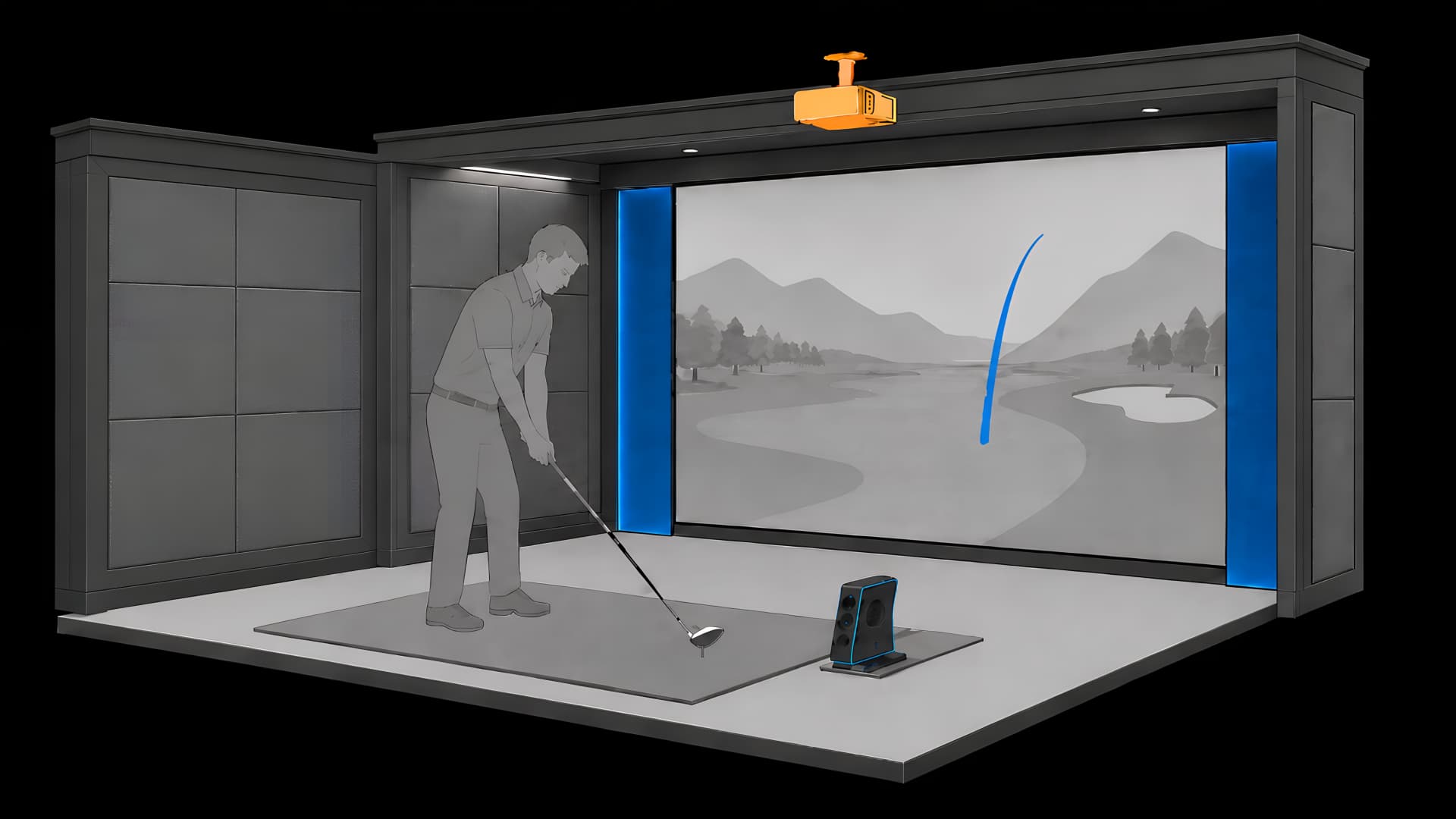
A professionally finished custom install commonly lands around $35,000 – $85,000+. You are paying for a room planned around swing clearance, screen size, monitor geometry, quiet upstairs living, and finishes that belong in the house, not only for a taller stack of boxes. Many complete single-bay residential projects sit in the middle of that band when layout, enclosure architecture, turf, lighting, acoustics, projection, a quality launch monitor, and calibration are included.
From about $85,000 to $250,000+, the simulator is often one use inside a larger entertainment space: bespoke millwork, lounge seating, theatre-grade AV, or estate-level finishes. Multi-bay amenities and entertainment wings can go higher and should be scoped as architecture first. Buyers underestimate garage climate control, bulkheads on the hitting line, wall protection beyond the screen, and the gap between labour to place gear versus owning the finished result.
DIY projector bay
About $3,500 – $15,000
Impact screen, enclosure, short-throw projector, mid-tier monitor, and a PC. The most common serious DIY build. Plays courses and looks like golf, but usually still reads as equipment in a space.
Kit / package bay in a ready room
About $12,000 – $30,000
Better hardware than DIY, often with paid mounting, but still mostly an equipment package in a space you already finished. Usually light on acoustics, built-in finishes, and true home integration.
Finished custom install
About $35,000 – $85,000+
A permanent golf room built into the home: framing, finishes, acoustics, turf, projection, launch monitor integration, and calibration as one project. This is the main band for professional residential installs.
Luxury / estate entertainment room
About $85,000 – $250,000+
Bespoke millwork, lounge seating, theatre-grade AV, multi-sport use, or estate-level finishes where the simulator is one element of a larger entertainment space.
Where the money goes
In DIY projector rooms, the launch monitor is often 30 – 50% of year-one spend. In finished custom installs, construction and finishes frequently become the larger share. That is why two people can both say they “bought a golf simulator” and report wildly different totals.
Component prices below are approximate North American retail ranges; Canadian pricing varies with exchange rates and distributors.
| Component | DIY / budget | Mid-range | Finished |
|---|---|---|---|
Launch monitor Often 25–45% of a DIY bay; a smaller share of a fully finished room once construction is included. | $500 – $2,000 | $2,000 – $7,000 | $7,000 – $25,000+ |
Enclosure / impact screen Nets are cheapest. Tensioned screens and custom framed enclosures change both feel and finish. | $200 – $1,500 | $1,500 – $5,000 | $5,000 – $20,000+ |
Projector Throw ratio is critical to avoiding shadows and placing the projector safely, while brightness determines how well the image holds up under room lighting. | $0 – $900 | $900 – $2,500 | $2,500 – $8,000+ |
Turf / hitting surface Joint-friendly mats and continuous turf transitions are where finished rooms pull ahead of kits. | $150 – $400 | $400 – $1,200 | $1,200 – $6,000+ |
PC / software (year 1) Subscriptions of roughly $200 – $1,200/year continue after year one on many platforms. | $0 – $1,200 | $1,200 – $2,500 | $2,000 – $5,000+ |
Electrical, lighting, protection Dedicated circuits, wall protection, and lighting scenes are easy to underestimate. | $0 – $800 | $800 – $3,000 | $3,000 – $15,000+ |
Framing, finishes, acoustics This is the gap between a kit in a corner and a room that feels built into the house. | $0 – $1,000 | $1,000 – $8,000 | $10,000 – $80,000+ |
Design + professional installation Labour alone for a prepared room is far less than a design-build that owns the finished result. | $0 (self) | $500 – $5,000 | Included in project scope |
What changes the price
Software subscriptions often run about $200 – $1,200 per year. Mats compress, screens scuff, and projectors age. Room prep is the silent line: dedicated circuits, garage heat, acoustic treatment under living spaces, and impact protection beyond the screen can add thousands even when a package looked complete.
Ceiling height, width for left- and right-handed play, and depth for tee distance and projector class all change monitor and layout choices. Basements hide ducts and beams at the hitting line. Garages need climate control. Designing before drywall closes is almost always cleaner than cutting into a finished level later. See room size, ceiling height, and the 3D room planner before you lock a hardware list.
DIY wins when the room is clear, you can mount equipment, and you accept a more technical look. Professional installation wins when the room must feel permanent, stay quiet upstairs, match the home, or coordinate with a renovation. The quietest way to overspend is buying the most expensive launch monitor first. The cheapest way to waste money is underbuilding the enclosure and acoustics so a good monitor lives in a room nobody uses. Still deciding between a practice net and a full screen bay? Start with net vs enclosure. For monitor trade-offs, see our launch monitor guide.
In Toronto and the GTA, many finished residential rooms land around $35,000 – $85,000+ depending on basement versus garage scope, launch monitor tier, and finish level. Quiet operation near upstairs living, older-home access, and renovation timing are common local drivers. For a custom scope tied to your room, request a consultation or start with Toronto installation details.
FAQ
How much does a golf simulator cost?+
A usable home golf simulator can start around $500 – $3,000 for a DIY net-and-monitor practice setup, land between $3,500 and $15,000 for a common DIY projector bay, and run $35,000 – $85,000+ for a finished custom install. Luxury and estate rooms often sit at $85,000 – $250,000+ when finishes and home integration expand the scope. Improvised practice under $500 exists, but it is practice gear, not a finished room. The right number depends on whether you are buying components or commissioning a finished space.
How much does a home golf simulator cost?+
Home golf simulator cost follows the same bands: roughly $500 – $3,000 for entry practice with data, $3,500 – $15,000 for a typical DIY projector bay, and $35,000 – $85,000+ when the room is framed, finished, quiet, and calibrated as a permanent install. Kit and package bays in the teens or twenties can buy better hardware, but they are still usually equipment in a ready room rather than a built-in finish. Price the outcome you want, not only the launch monitor SKU.
How much does it cost to install a golf simulator?+
Installation labour alone on a prepared room can be a few hundred to a few thousand dollars. A full design-and-install project that includes framing, finishes, turf, projection, launch monitor integration, and calibration is a different product: many custom residential rooms fall in the $35,000 – $85,000+ range, with luxury builds higher. Always separate hardware line items from the cost of making the room permanent and quiet enough for real household use.
How much does golf simulator installation cost?+
Golf simulator installation cost depends on scope. Mounting a kit in a ready space is often a short labour line item. Building the room around the simulator (enclosure architecture, impact protection, electrical, acoustics, turf, projection, and commissioning) is usually the majority of a finished-room invoice. In Toronto and the GTA, many professionally finished residential installs land around $35,000 – $85,000+ once design and construction are included.
What is the cheapest golf simulator setup?+
The lowest practical setups with measured data pair an entry launch monitor or phone-based unit with a net and mat, often roughly $500 – $1,500. Below that you can practice into a net with almost no technology, sometimes under $500 if you already own a mat or use household materials carefully. Cheap works for learning; it rarely feels like a finished golf room and usually lacks course play.
Why do some golf simulator rooms cost $40,000 to $100,000?+
Because the budget includes construction and finish work, not only a launch monitor. Framing, impact protection, turf, lighting, acoustics, electrical, projector mounting, and calibration add up when the room must look intentional and stay quiet upstairs. That is the difference between a kit and a built-in room.
Do golf simulators have ongoing costs?+
Yes. Many platforms charge annual software subscriptions, commonly about $200 – $1,200 per year. Mats and screens wear, projectors age, and calibration may need a refresh after renovations or hardware swaps. Factor five-year software cost into the real total.
Is a DIY golf simulator cheaper than professional installation?+
DIY is usually cheaper in cash if you already have a workable room and the skills to assemble, mount, and troubleshoot. Professional installation costs more upfront and reduces the risk of clearance mistakes, loose screens, noisy rooms, and unused gear. For many homeowners the finished-room path is better value when the space sits under living areas or must match the rest of the home.
Does room size change the cost of a golf simulator?+
Yes. Tight ceilings can force different launch monitors and layouts. Garages often need insulation and heat. Older homes may need custom framing around beams. Larger luxury rooms invite seating, millwork, and lighting that DIY kits never include. Measure first; price second.
Are golf simulator prices in CAD or USD?+
Retail launch monitors, projectors, and many enclosures are often listed in USD. Finished custom rooms quoted in Canada are usually CAD and include local labour and construction. Comparing a USD monitor sticker to a CAD finished-room total mixes currencies and scopes. Convert carefully and ask which line items are equipment retail versus installed project cost.
How much does a golf simulator cost in Toronto or the GTA?+
Component pricing often tracks North American retail, but finished installs reflect local labour, access, and housing stock. Many custom residential projects in Toronto and the GTA land roughly in the $35,000 – $85,000+ band depending on basement versus garage work, monitor tier, and finish level. Share photos and goals for a clearer read on your specific room.
What costs do buyers most often underestimate?+
Room prep, acoustic treatment, electrical, quality hitting surfaces, and software subscriptions. People also underprice time: DIY projector bays can absorb evenings of alignment and troubleshooting. In finished rooms, garage climate control, bulkhead work, and wall protection are common additions once a layout is honest about full swings and year-round use.